
“I work with painting as a space where intimate gestures, digital memory, and contemporary fragmentation come together. I’m interested in the tension between what we choose to share and what we keep hidden, the images we save as drafts, private archives, or unfinished thoughts. Through fragments -lines, stains, found shapes- I build hybrid surfaces that feel like visual diaries, always in a state of construction and collapse. Painting, for me, is a way to assemble, collect, and let go all at once; a place to hold what can’t quite be held. My work invites a slower kind of looking, one that resists the speed and constant scrolling of digital culture. I want viewers to move around the paintings, find hidden layers, and let the story shift depending on where they start. ”
Nadia Jaber is a Spanish-Palestinian contemporary artist whose work explores painting as a space where memory, fragmentation, and absence intersect. Her practice approaches painting not merely as a medium, but as a conceptual and philosophical field shaped by deconstructive thought. Drawing on ideas of différance and citation, she understands each painting as a living structure: open, unstable, and in constant dialogue with its references.
Her current body of work, Floral Arrangements, reimagines the traditional still life as a site of impermanence and perpetual decomposition. Floral motifs appear as fragile constructs, always on the verge of disintegration, questioning the possibility of capturing or preserving any fixed essence. Presence, in these paintings, is inseparable from absence; each image carries the trace of what is already disappearing. Through this embrace of ephemerality, painting becomes a space where meaning remains provisional and continually renegotiated.
Jaber’s broader practice engages with fragmentation, digital memory, and the circulation of images in contemporary culture. In earlier series such as Swipe for the details, she assembled fragments from classical and contemporary paintings into hybrid surfaces, evoking both the physical gesture of digital consumption and the conceptual movement of deferral. These works navigate visual histories as if browsing them, jumping between textures, references, and temporalities.
Her series About:blank extends this inquiry into the logic of digital culture and its invisible architectures. Treating the blank surface as a charged field rather than a void, Jaber reflects on algorithms, attention, and the conditions under which images appear and disappear. Her paintings operate as slow, tactile counterpoints to the speed of online visual culture, demanding prolonged and embodied viewing.
Across all her work, Jaber’s distinctive style merges precise, almost surgical brushwork with visible seams and layered fragments. By weaving together techniques traditionally associated with craft and logics drawn from digital culture, she creates a visual language that is at once intimate, rebellious, and rigorously conceptual.
Nadia Jaber lives and works in Barcelona. Her work has been featured in 15 Emerging Female Artists To Invest in Before They Blow Up, selected by Saatchi Art Head Curator Rebecca Wilson, and her paintings have been included in interior design projects featured in AD Spain and Maison Créative. Through her practice, she invites viewers to experience painting not as a finite, resolved object, but as a dynamic process of becoming: a field of traces, absences, and infinite possibilities.
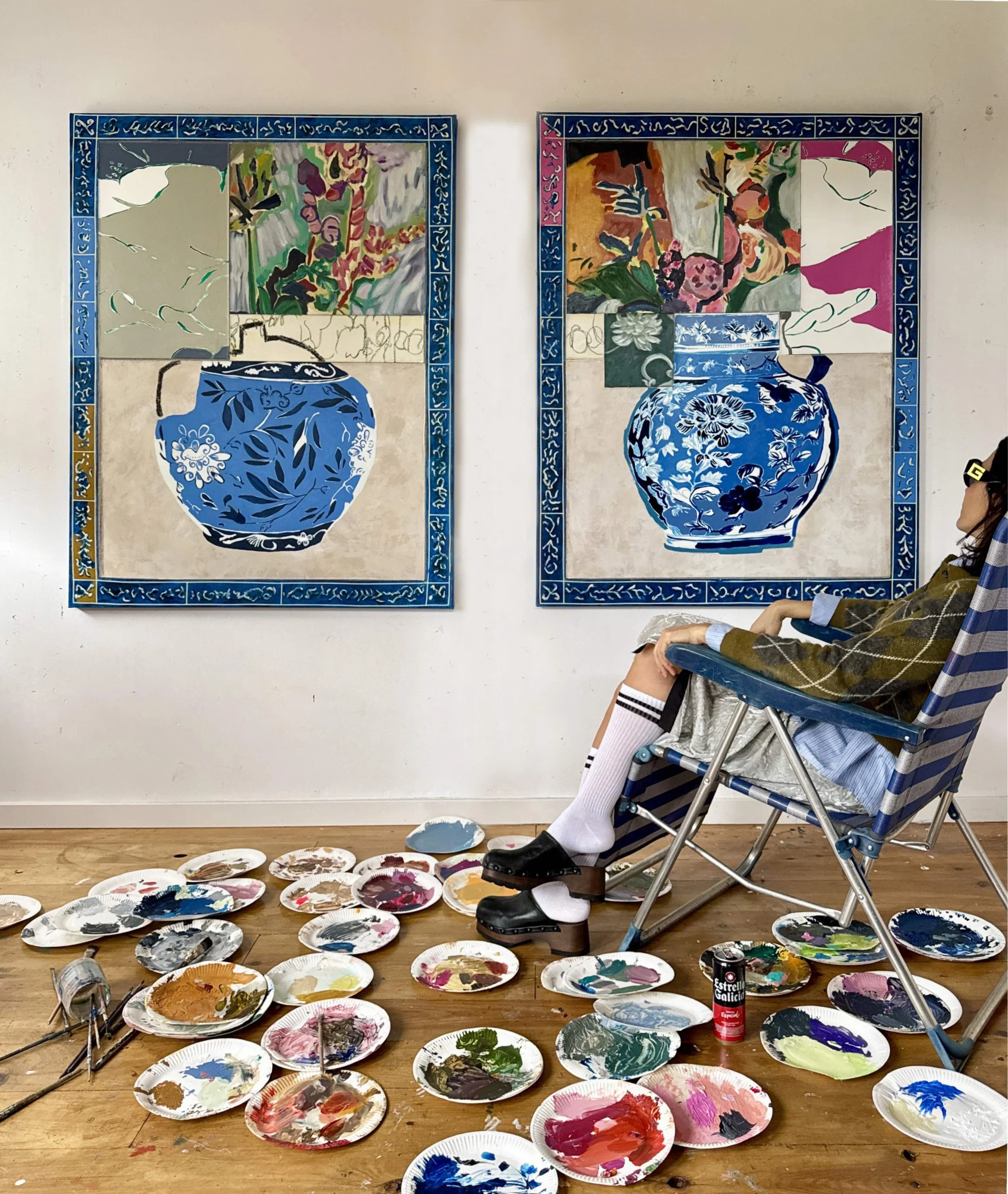
Nature as a way of paying attention. Slowing down, looking twice, finding the extraordinary in the ordinary. That’s what lives behind the work, canvases sewn together, fragments becoming one thing, slowly, stich by stich.
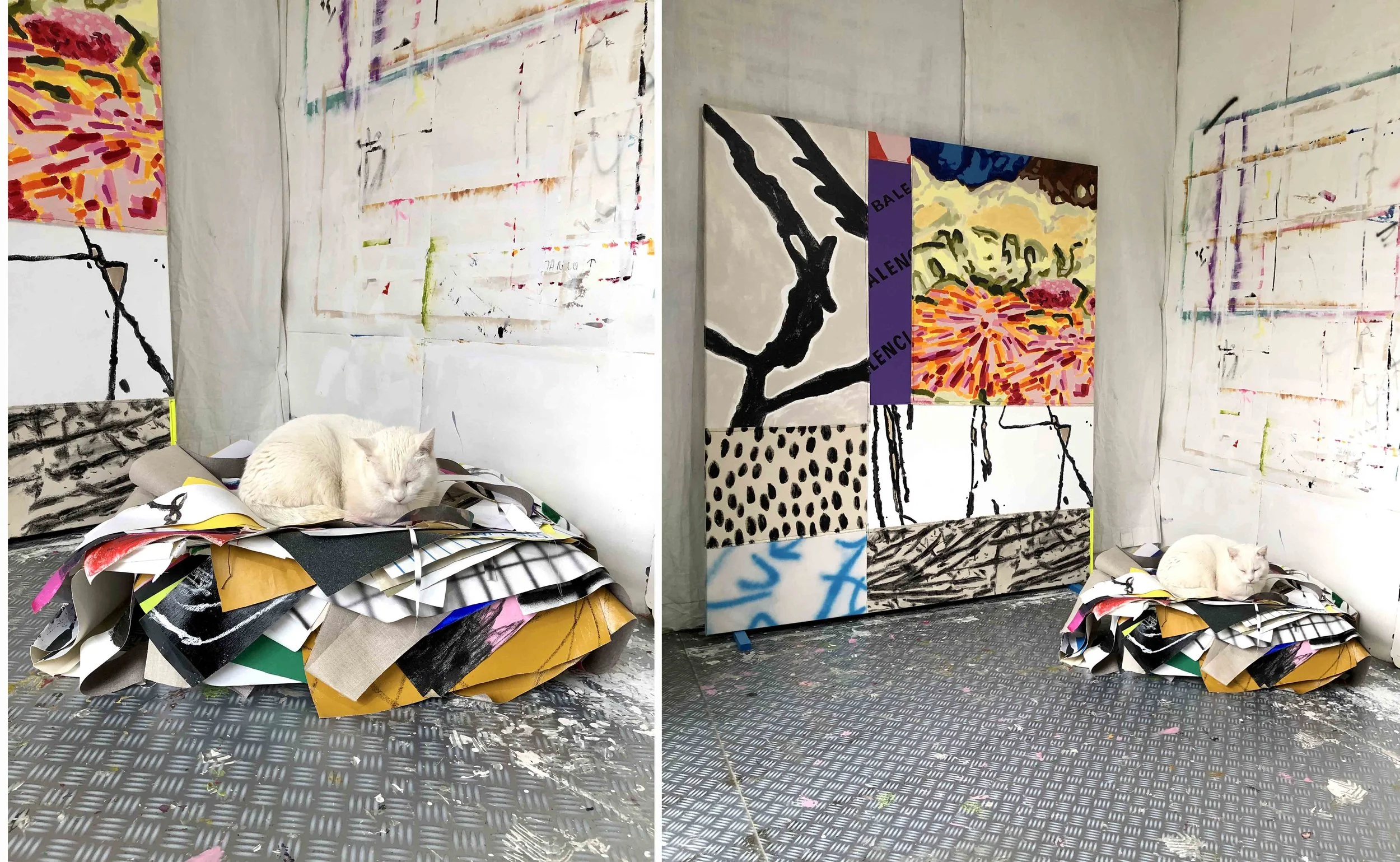
“411 Length Required” follows a deconstructivist approach, combining elements from past works, sketches, and structural experiments. Like the cat’s makeshift bed, it’s composed through intentional layering and reconfiguration.
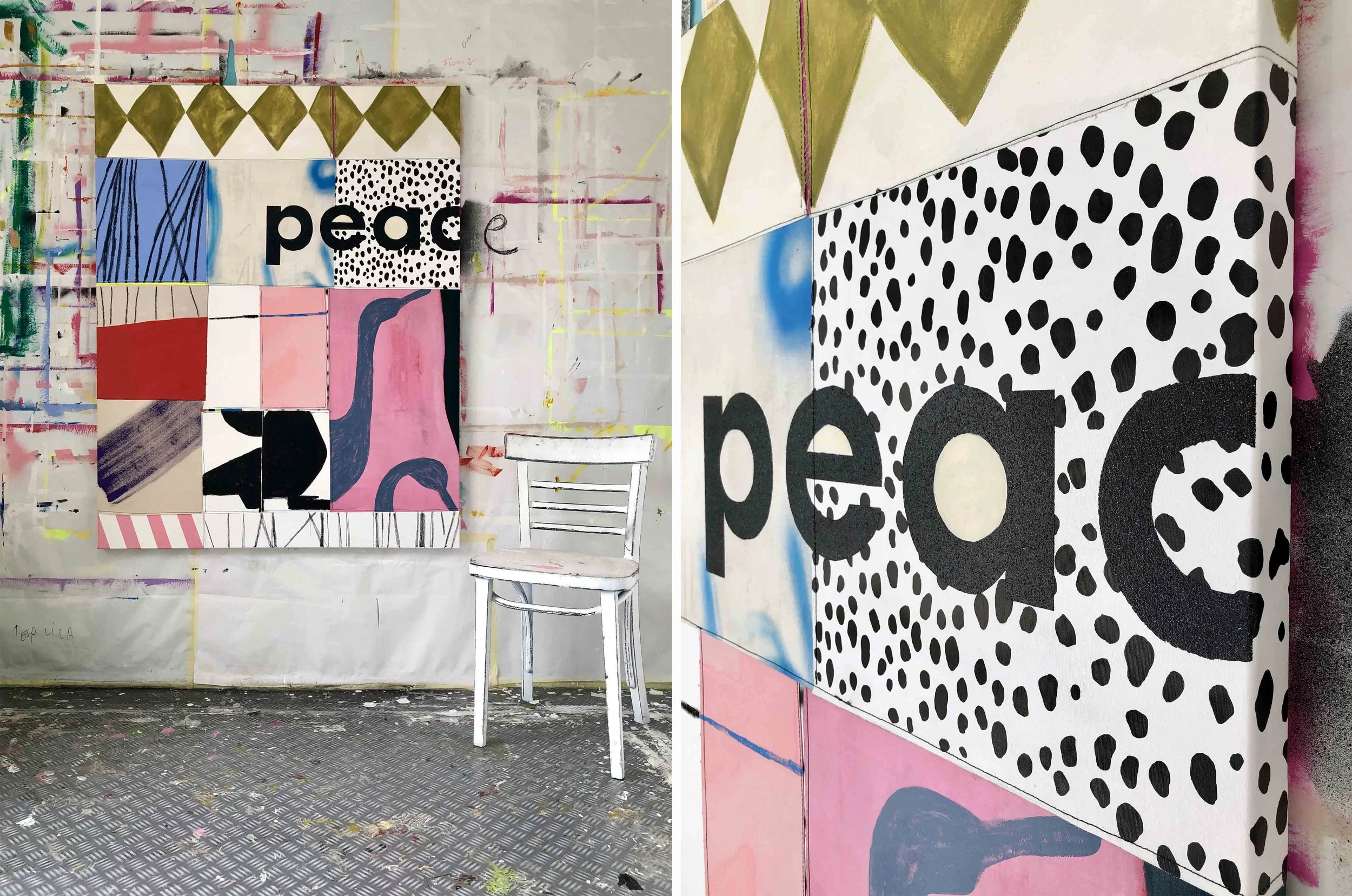
The image on the left shows the work “510 Not Extended” in its early assembly, stitched canvas fragments coming together like a patchwork of intentions. On the right, a closer view reveals the tactile logic of the piece: layered textures, sprayed stencils, and overlapping gestures that echo the way digital memory stores, distorts, and recomposes.

Left: assembling stitched canvas fragments on the sewing machine. Right: the finished work “Tan platónico que duele” installed, the seams between its parts still visible, carrying the memory of its making.